- Products
- Service
- Project Business
- References
- fischer group
- Contact

- Home
- References
- On secure tracks through the Apennines

Shifting traffic from road to rail, reducing environmental impact, optimizing passenger and freight transport connections – this is achieved by the project to expand the Italian Apennine transversal line between the cities of Orte and Falconara. On the section Orte–Foligno of the railway line, a dielectric fischer fastening system for electrical installations was used.
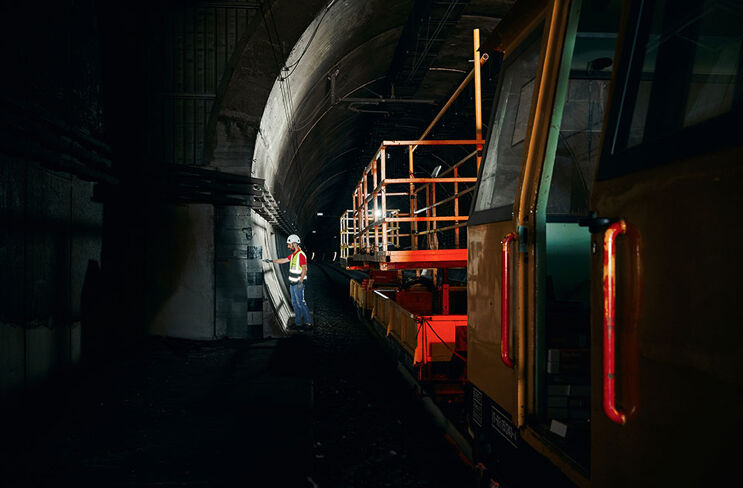
The goals of the extensive expansion of the Apennine transversal Orte–Falconara are to expand passenger transport connections between the important coastal regions of the Tyrrhenian Sea (west) and the Adriatic (east), to create an efficient freight transport route along the north-south corridor, and to reduce travel times for commuters, tourists, and all other traffic participants between cities such as Rome, Ancona, Perugia, and Falconara. The railway line crosses the Apennine mountains (also plural the Apennines) and connects important regions of Italy. As part of the project, certain sections of the route are being doubled to increase capacity and efficiency. The work is divided into several phases and includes the modernization of the infrastructure. The expansion is carried out according to the latest safety standards. For the expansion of the section Orte–Foligno, the fastening specialist fischer supplied the dielectric anchoring system to secure backbone cables of several systems and installations.
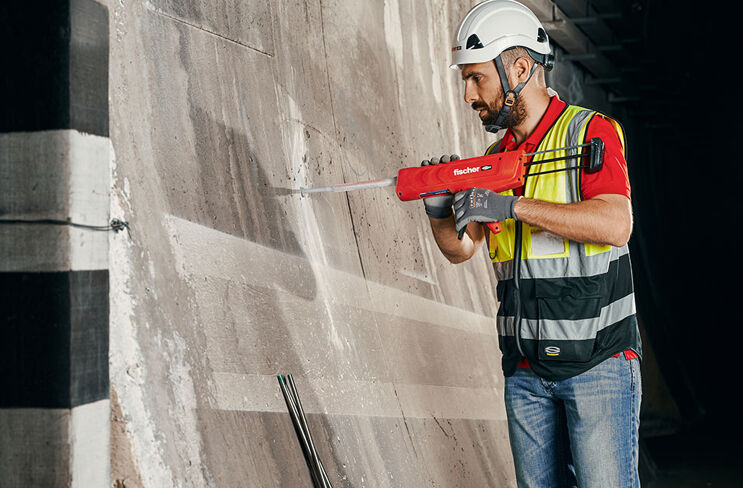
This has realized the European Rail Traffic Management System (ERTMS), an advanced, unified European signaling and speed control system that ensures the interoperability of national railway systems. The backbone cables also form the backbone of GSM-R (Global System for Mobile Communications – Rail). This international wireless communication standard for railway traffic ensures reliable communication between trains and railway control centers. The TLC (Telecommunications) is also secured. This includes communication systems for the safe and efficient operation of trains and railway infrastructures, which are crucial for the transmission of data and voice communication between trains, signal boxes, and operations centers. Installations for track control, lighting, and traction vehicle systems also secure the systems along the route.
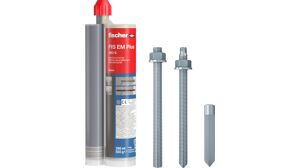
The dielectric cable fastening from the fastening expert fischer is non-conductive and serves to prevent stray currents – and consequently unwanted electromagnetic interference. Such systems comply with the RFI specifications (Rete Ferroviaria Italiana) for cable trays, which impose high demands on the safety and efficiency of cable routing. The fischer injection system FIS EM Plus with threaded rods as well as dielectric DD centering clips, which ensure electronic shielding, were used.
The system solution guarantees the insulation of the anchor rods against the passage of stray currents and thus their protection against corrosion. On the construction site, DD-E and DD-S clips in the M12 version were used together with M12 threaded rods, each of which had an eye bolt screwed onto the end to carry the load of the cable tray. The fischer FIS EM Plus received the technical suitability declaration from RFI for the application, as it complies with the technical specification STC STS ENE SP IFS TE 673 A from RFI.

Our FIS EM Plus injection system with threaded rods as well as DD-E and DD-S centering clips guarantees an electrical resistance of more than 1,000 Ω at a direct voltage of 1,000 V, without the need to increase the drill hole diameters specified in the European Technical Assessment ETA-17/0979, thus enabling CE marking.
The centering clips ensure, in these and other projects, not only electronic shielding but also the precise alignment of the anchor rod in the drill hole and prevent the threaded rod from falling out during overhead fastening – even with anchor rods of considerable length and weight as well as chemical anchors with long processing times. Their use does not require larger hole diameters than those specified in the ETA. This leads to significant mortar savings compared to the use of conventional electrical insulation devices. All of this results in cost and time reduction during installation. The calculation of the injection system is straightforward with the C-FIX module within the FiXperience design software.